- Dance
- Galleries & Institutions
- Industry Analysis
Dance, Digitalization, and Visibility: Why Institutions Need to Rethink
Why dance institutions need to rethink their digital presence
 AI-generated
Dance is the cultural discipline that suffers most from a structural contradiction: it exists entirely in the moment of performance and at the same time has to be digitally visible in order to reach that moment at all. No other cultural field has such a fundamental documentation problem. A painting can be photographed without significant loss. A novel can be quoted. A choreography translated into moving image loses precisely what makes it what it is: space, live energy, the immediate physical presence between dancers and audience.
This peculiarity explains why dance institutions often appear weaker in digital space than comparable institutions in theater, music, or the visual arts—not for lack of commitment, but because the obvious solution, “just film it,” does not do justice to the medium itself.
 AI-generated
The Documentation Problem as a Starting Point
Most dance institutions solve the problem in one of two unsatisfactory ways. Either they largely forgo digital documentation and rely on programs, press photos, and word of mouth, which drastically limits reach. Or they produce complete performance recordings that document but rarely communicate: long, uncut videos that no one outside an already interested professional audience watches in full.
Both solutions miss what digital presence should actually accomplish for a dance institution: not to replace the performance, but to generate curiosity about it, and to make the practice of choreographers and dancers visible beyond the individual performance.
What Digital Presence Can Actually Mean for Dance
The strategically most effective examples from the international dance scene—such as the digital communication of institutions like Sadler’s Wells in London or Nederlands Dans Theater—take a different approach. They treat digital content not as a substitute for the performance, but as a format of its own with its own logic.
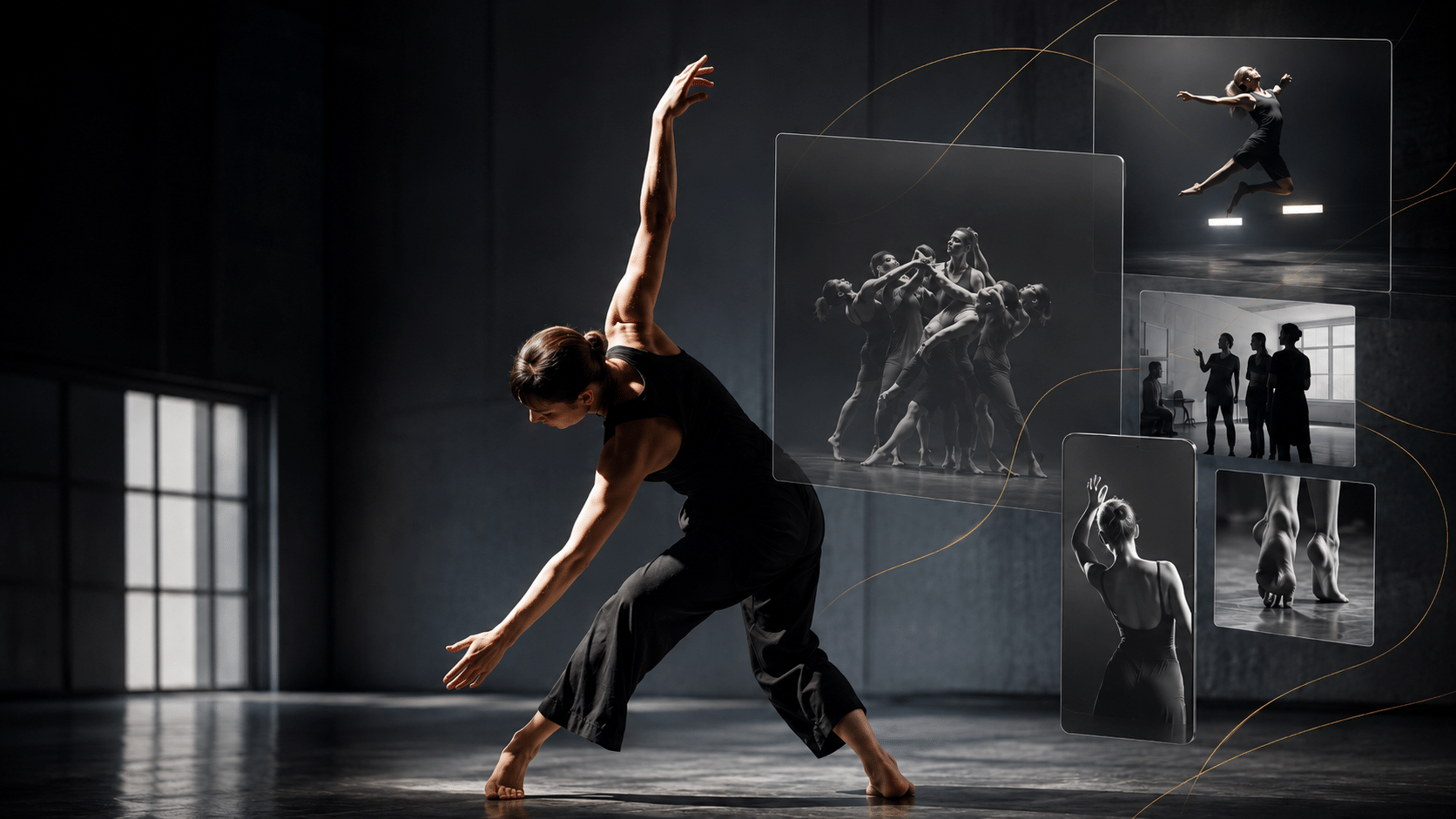
Concretely, that means: short, focused moving-image excerpts that show a single choreographic moment instead of the entire performance. Rehearsal material that makes the process of creation visible and thereby creates a different kind of closeness than the finished piece. Portraits of choreographers and dancers that show the person behind the movement. Texts that explain choreographic decisions without trivializing them.
These formats do not document the performance, they communicate the practice. That is an essential difference that is too rarely made explicit in the conception of digital communication for dance institutions.
Physicality as Communicative Capital
One peculiarity of dance that can be used strategically for digital communication, rather than merely treated as a problem, is its physicality itself. Dance communicates through the body in a way that stands out and generates attention in an increasingly text-based, abstract digital public sphere.
Institutions that understand this use visual language—photography, short moving-image moments, image compositions—as a core means of their digital identity, rather than subordinating it to text communication. The aesthetic consistency of this visual language over time creates a recognizability that is as important for the institutional brand as it is for individual choreographers.
Why Dance Institutions Often Lag Behind Theaters and Music Venues
One structural reason for the digital restraint of many dance institutions lies in production budgets. High-quality moving-image production that does justice to the physicality and dynamics of dance is more labor-intensive and expensive than documenting a concert or a theater performance with a primarily static camera. Many dance institutions, especially smaller companies and independent choreographers, simply lack the means for professional moving-image production at the required quality.
This leads to a vicious circle: without a convincing digital presence, it is harder to win new audiences, funding, and international attention, which in turn limits the means for better digital production.
The way out of this cycle rarely lies in bigger production budgets, but in a changed understanding of what digital dance communication should accomplish. Short, simple, but conceptually well-considered formats—a single choreographic moment, filmed precisely with a smartphone but with a clear curatorial idea behind it—often communicate more effectively than elaborate but conceptless full productions.
 AI-generated
Community Building Beyond the Performance
Dance institutions that use digital presence strategically are increasingly building communities that extend beyond individual performance dates. Workshops, open rehearsals, digital glimpses into choreographic processes, exchange formats with the audience—these formats create a continuous relationship with the institution that is not tied to individual seasons.
This continuous relationship is especially valuable for dance institutions because it directly counteracts the discipline’s fundamental problem: the fleetingness of performance. A performance is over after a few evenings. A digital community interested in an institution’s practice remains and can be activated again for the next production.
Strategic Consequence for Dance Institutions
What follows for dance institutions that want to rethink their digital presence? The first step is moving away from documentation thinking—away from the question “How do we film the performance?” toward the question “Which standalone digital formats communicate our practice most effectively?”
The second step is the deliberate use of physicality as a visual trademark, not as a problem that has to be solved. The third step is building continuous digital relationships with the audience that extend beyond individual seasons.
Dance will never be fully translatable digitally, and that is not the goal. But between complete digital abstinence and inadequate documentation lies a space in which digital communication can make an institution’s practice visible without betraying it.
Favori Media develops digital communication strategies with cultural institutions that do justice to the inherent logic of their artistic discipline—from dance and theater to the visual arts and music.