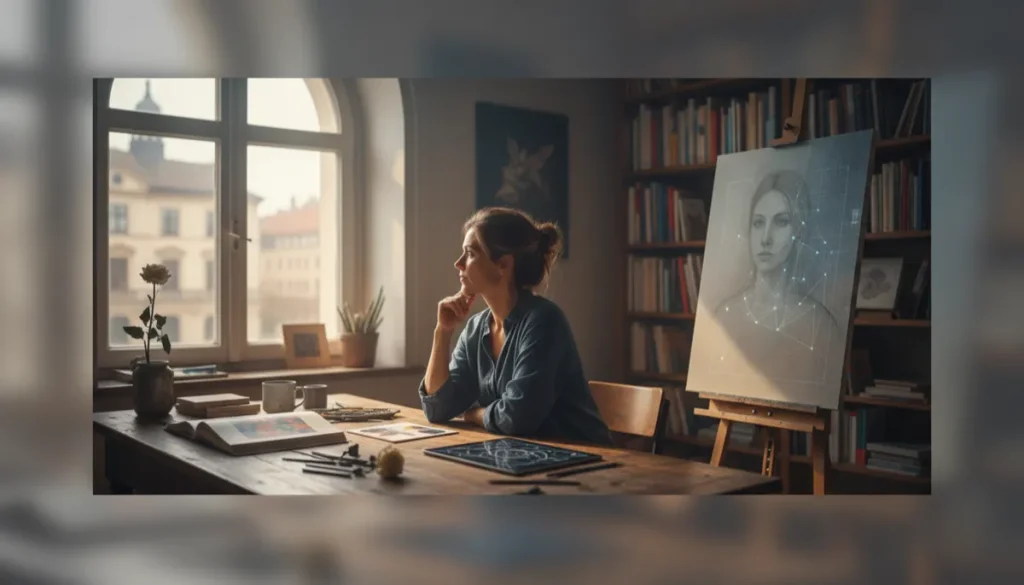
 AI-generated
Reach creates attention, reputation creates trust. Many followers and views often change the perception of an artistic position only slightly. Only stance, consistency and deliberately placed traces online turn visibility into digital reputation.
Reach Is Not the Same as Reputation
In many conversations in the art market, the same sentence comes up: “Our reach has grown, but nothing is happening.” Follower counts grow, videos get thousands of views, exhibitions are accompanied intensively on social media, and yet the perception of an artistic position or a venue changes only marginally. The strategic misconception behind this: that visibility automatically translates into reputation, trust, and cultural relevance. This is exactly where the misunderstanding around digital reputation in the art and culture field begins.
 AI-generated
When Visibility Becomes an Illusion
The logic of the platforms is seductively simple: more reach means more success. For creative brands, artists, galleries, and cultural institutions, however, this equation works only to a limited degree. High visibility does not automatically create brand trust. A post that briefly goes viral says little about whether an artistic position is perceived as relevant, consistent, and credible. It merely shows that a moment generated attention, not that a brand reputation has deepened.
Attention is fleeting and context-free if it is not embedded in a clear strategic positioning. A reel from the studio, a quick look at an exhibition install, a spontaneous statement in the feed: all of this can spark interest, but often remains unrelated to an overarching narrative. Who you are, what your practice stands for, which cultural visibility you are aiming for, none of this reveals itself automatically from the sum of individual, isolated pieces of content.
Digital presence without substance remains superficial. It creates the feeling of activity, but not necessarily of relevance. For the art market, which builds on trust, context, and long-term relationships, this is a critical difference. Those who only broadcast, without conveying a recognizable stance, run the risk of being visible, but still not truly perceived, at least not where decisions about collaborations, acquisitions, or institutional invitations are made.
The paradox of reach shows itself exactly here: it is possible to be very present digitally and at the same time remain structurally invisible. Visible in feeds, invisible in relevant search results. Loud in stories, quiet in the minds of decision-makers. Those who confuse reach with reputation invest energy in the wrong metric, and overlook that digital reputation demands a different, deeper quality of visibility.
Digital Reputation: What Really Counts
Digital reputation is more than a positive impression while scrolling past. It describes the sum of the signals that a brand, a studio, a gallery, or an institution sends out over time, and how consistently these signals can be read. Trust arises through consistency, not through frequency. Twenty posts per week without a clear line are worth less than a continuous, well-curated stream of content that makes a position understandable and deepens it.
Reputation develops over time and context. Especially in the art market, where references, embeddings, and discourses are decisive, it is not enough to simply “be there.” Cultural brands need recognizability, context, and stance. Recognizability means not only a visual appearance, but a clear line of content: Which topics drive you? Which aesthetic language do you pursue? Into which cultural and societal conversations do you intervene, and how do you do it?
Stance, in turn, is not communicated through slogans, but through the way content is selected, formulated, and framed. Thought leadership in cultural marketing emerges where a brand shows not only what it does, but also how it thinks. Those who take a position create orientation, and with it the foundation for brand trust. The distinction between attention and trust is central here: attention can be bought in the short term or generated algorithmically; trust can only be built through comprehensible, repeated, and credible communication.
Digital reputation therefore means that your own presence leaves a coherent impression across different channels: website, journal, social media, press voices, interviews, search results. Only in interplay does a picture emerge that points beyond individual posts and makes a creative positioning truly legible.
The New Logic of Digital Perception
Before a gallery is contacted, a collaboration requested, or a studio visited today, a quiet digital run-up usually takes place. Search results, content, and the entire digital presence shape perception long before the first conversation. Those interested in an artistic position do not only type the name into Google, but move through a chain of impressions: website, press articles, interviews, social media profiles, perhaps a podcast or a curated journal.
People inform themselves before they make a decision, whether it concerns acquisitions, exhibition invitations, residency applications, or long-term partnerships. In this run-up, digital reputation arises: quietly, often without direct contact, but with great effect. Those who research online form a picture before the first word is exchanged. This picture is rarely neutral; it is shaped by what is findable, how professional it looks, what depth of content becomes recognizable, and how well the different traces fit together.
What Google shows about a brand is de facto the first encounter. Visibility in the art market is thus increasingly shifting into this digital anteroom. Whether a gallery is read as internationally connectable, whether an institution is perceived as curatorially distinctive, whether a studio is considered a reliable partner. All of this is today already anticipated on the basis of digital traces. Digital visibility is therefore not only a question of presence, but of curated perception: Which content is in the foreground? Which questions does it answer? Which stance does it convey?
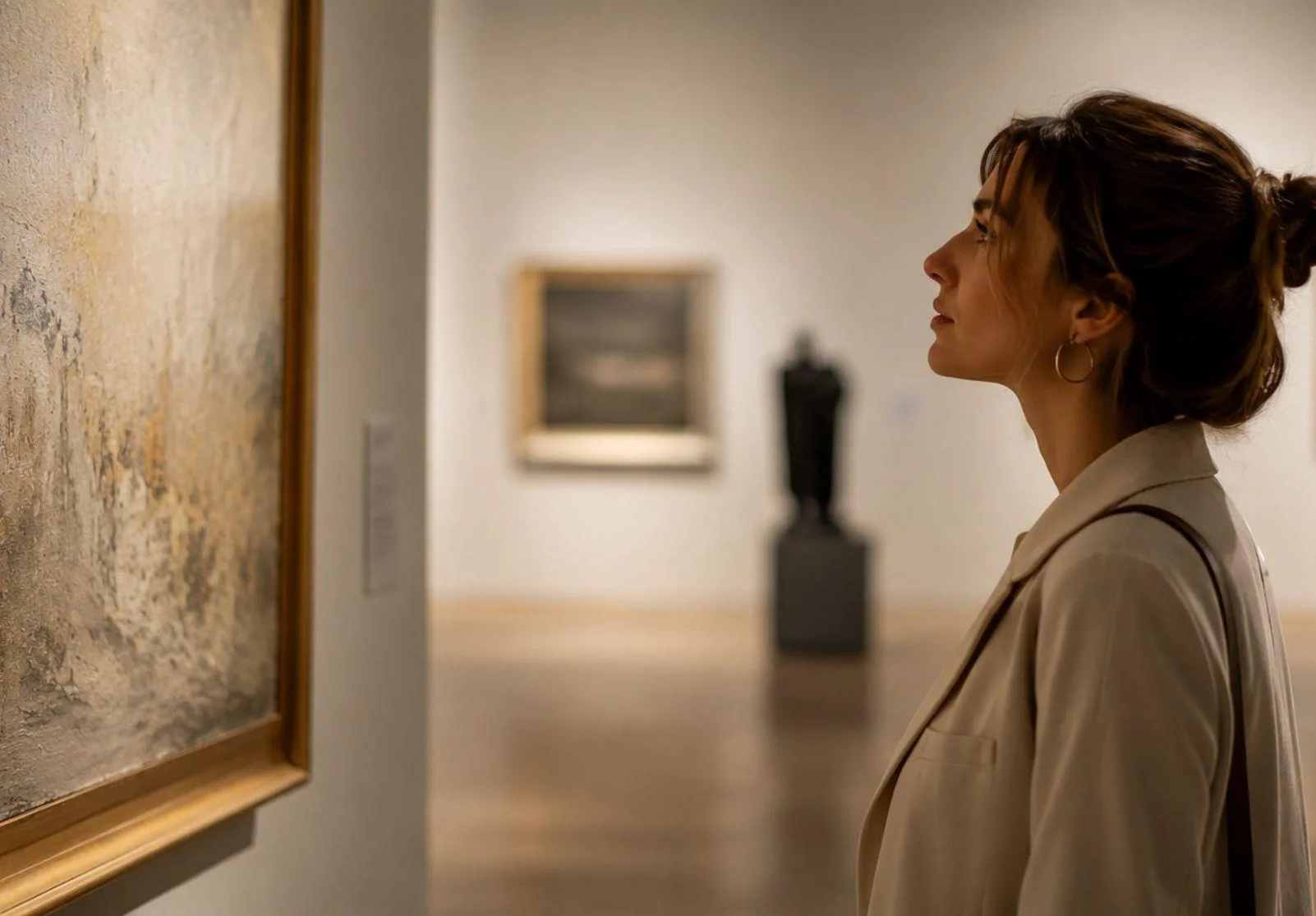
 AI-generated
Curated emptiness creates room for perception, digitally as in physical space.
Why Many Creative Brands Misunderstand Visibility
Many creative brands orient themselves toward metrics that stem from the logic of mass marketing: followers, impressions, click counts. The focus is on numbers instead of positioning. In the process, it is overlooked that a clear creative positioning is the actual currency in the art and culture field. A gallery with 5,000 precisely targeted followers can act more effectively than a profile with 50,000 random subscribers with no connection to its own program.
Reach without identity and without context remains fragile. It can hardly be translated into relationships, trust, or collaborations. Short-term trends (new formats, challenges, effects) often displace long-term brand building. What brings attention in the short term not infrequently dilutes one’s own language. The consequence: the brand remains interchangeable in the stream of content, instead of being perceived as an independent voice in the art market. Visibility in the art market, however, means more than presence in feeds; it means connectivity to discourses, collections, institutions, media.
Added to this: inconsistent communication weakens brand perception. When website, social media, press materials, and personal appearances tell different stories, no clear picture emerges. For potential partners, collectors, or curators, it is then hard to assess what a brand actually stands for. The consequence is reticence, and with it a loss of opportunities that is rarely directly readable in numbers, but has an effect in the long run.
The misunderstanding becomes especially clear where social media is used as the primary instrument, without a strategic basis. Platforms are declared the main stage, while website, journal, archive, and search results are neglected. Yet precisely these places are decisive when it comes to brand reputation and long-term brand trust. They are less fleeting, better curatable, and offer room for depth, context, and discourse.
From Attention to Brand Reputation
Virality is not the same as cultural relevance. A post that spreads quickly can be a symptom of resonance, but does not have to be. For building a sustainable brand reputation, what matters is whether a brand is perceived over time as a reliable, independent voice. Reputation is based on clarity, quality, and stance. Clarity in positioning, quality in content, stance in the way topics are set and negotiated.
Strong brands communicate for the long term and consistently. They do not follow every trend, but choose formats, channels, and topics deliberately. They develop an editorial line of their own, be it in a journal, a blog, a digital archive, or curated social media series. This is how thought leadership emerges: not through loud claims, but through continuous, reflective contributions that take other players in the field seriously and at the same time make a perspective of their own visible.
The difference between volume and meaning is subtle in the digital space, but decisive. Volume shows in frequency, effects, and short-term peaks. Meaning shows in the question of who remembers, who comes back, who recommends. For artists, designers, photographers, galleries, and cultural institutions, it makes more sense to think in relationships than in clicks. Brand reputation arises where content remains connectable, in conversations, in programs, in invitations, in collections.
 AI-generated
Quiet moments of concentration shape creative identity more strongly than loud effects.
Strategic Recommendations for Creative Brands
Those who want to build digital reputation deliberately and for the long term must think about visibility differently. Not as a short-term campaign, but as an ongoing, curated presence. The first step is a clear positioning as a foundation: Who are you? Who do you work for? Why do you do what you do? These questions sound simple, but are often insufficiently answered, especially in cultural marketing. A precise answer creates the basis for orchestrating content, formats, and channels in a meaningful way.
From this basis, it pays to publish high-quality content strategically in your own journal or blog. Not as a news feed that strings together dates, but as an editorial space in which artistic processes, backgrounds, collaborations, and stances become visible. Such content is findable over the long term, can be linked, quoted, and indexed in search engines. A central building block for digital visibility that has an effect beyond the day and sustainably supports visibility in the art market.
The website in this understanding becomes a strategic communication instrument, not a digital business card. It bundles the different levels of your work: portfolio, program, discourse, references. It creates orientation for different audiences: collectors, curators, partners, press, students. And together with journal, newsletter, and search results, it forms the foundation for a digital reputation that does not depend on individual platforms, but remains anchored in your own infrastructure.
SEO in this context becomes a long-term practice: visibility through relevance, not through reach. It is less about technical tricks than about structuring and naming your own content so that it becomes visible for the right search queries. A gallery, for example, that wants to stand for a particular curatorial line should make precisely these topics explicit in language, in texts, headings, project descriptions. This creates a digital presence that search engines perceive as consistent and surface accordingly, without lapsing into superficial keyword stacking.
What matters is prioritizing trust, not reach optimization. This means: rather fewer but more precise pieces of content; rather clear, repeatable messages than constantly new, unconnected impulses. Digital reputation arises when other players in the field can rely on your brand: in content, in form, in organization. This is exactly where Favori Media’s work comes in: the agency accompanies artists, galleries, and cultural brands in building this strategic visibility, with Favori Art, Favori Flow, and the Artpreneure approach, which brings together artistic practice, entrepreneurial thinking, and cultural positioning without making them uniform.
Long-Term Visibility as Quiet Infrastructure
Long-term visibility does not arise from volume, but from a quiet infrastructure that sustains over the years. Digital reputation is part of this infrastructure: it ensures that a brand, a studio, an institution remains findable, classifiable, and connectable, even when there is currently no exhibition opening, no fair appearance, no festival. It works in the background, in search results, in archive pages, in linked articles, in saved posts.
Reputation becomes the quiet infrastructure of creative brands when it is thought of beyond individual campaigns. It connects physical presence and digital traces, program and communication, artistic practice and institutional strategy. Those who want to build trust need context, clarity, and continuity, not only in the work, but also in the way this work is mediated publicly. This is exactly where it is decided whether a brand is perceived in the art market as a reliable point of reference or gets lost in the noise of content.
The strongest cultural brands are not heard the loudest, but perceived the most clearly. Their digital reputation is not a product of chance, but the result of deliberate decisions: Which stories are told? Which remain unspoken? Which traces should be visible when someone types the brand’s name into a search bar for the first time? Those who take these questions seriously shift the focus from short-term reach to long-term meaning, and build a presence that holds even when the algorithm changes again.
Long-term visibility rarely arises from short-term attention. What matters is how consistently trust, context, and reputation are built.
Favori Media supports artists, cultural institutions, and creative brands in developing exactly this strategic visibility over the long term.
Frequently asked questions
What is the difference between reach and reputation?
Reach measures how many people see something. Reputation describes how those people place a position, an institution or a brand, and whether they trust it.
Why does more reach often achieve nothing?
Because platforms reward speed, not relevance. A viral post says little about whether an artistic body of work is taken seriously and remembered.
How do you build digital reputation?
Through deliberate decisions: which stories are told, which traces are visible when someone searches the name? Consistency over time counts more than individual highlights.