- Art Market
- Strategy & Positioning
- Visibility
AI, Art, and the Future of Creative Visibility
Why artificial intelligence is changing cultural marketing—and why clear positioning is becoming the most important resource for creative brands.
 AI-generated
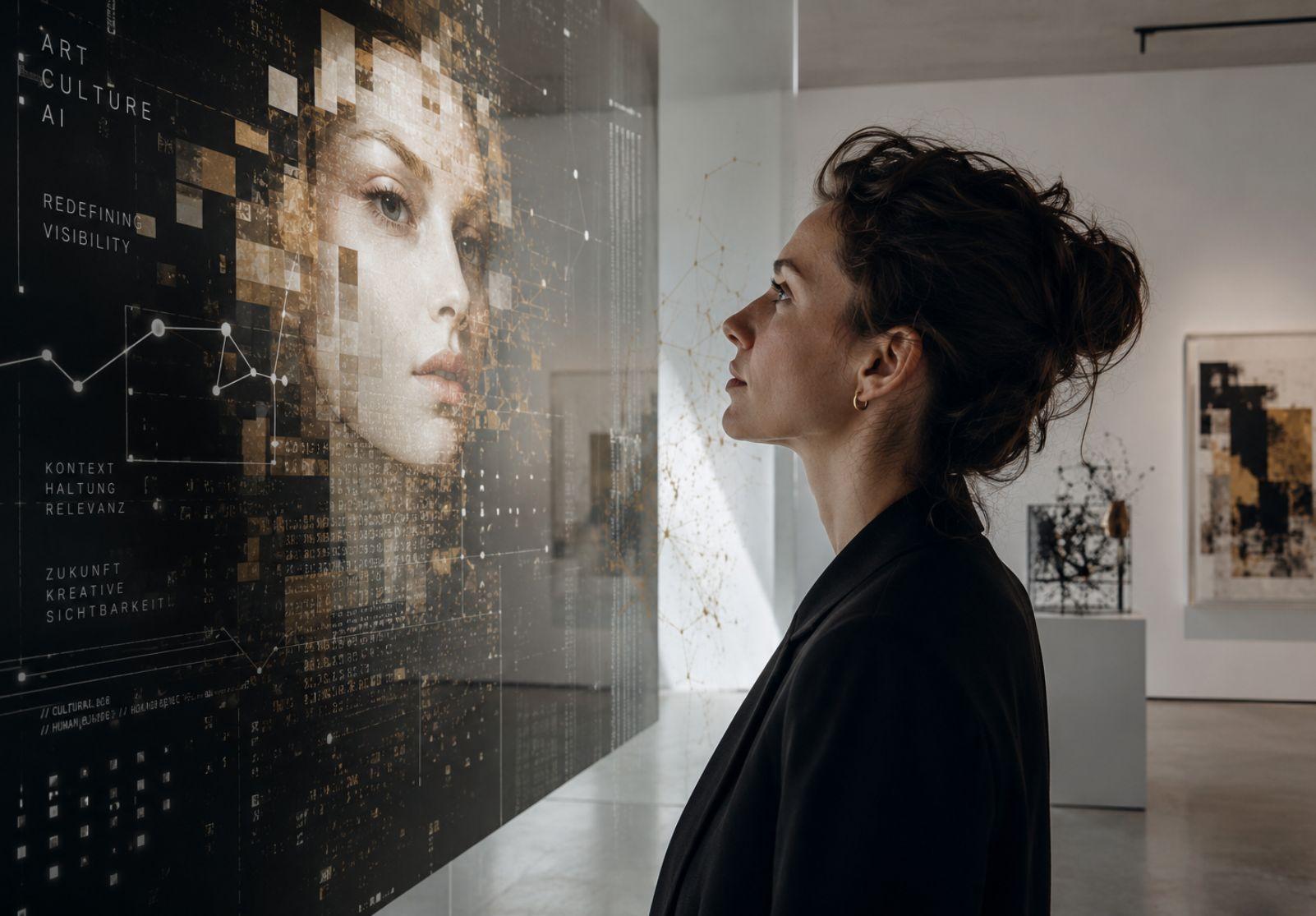
How AI is reorganizing art marketing, cultural brands, and digital reputation—and why stance, context, and positioning are becoming more important than sheer production speed.
 AI-generated
1. A Quiet Shift: When Visibility Becomes Infrastructure
In many artist studios, creative studios, and cultural institutions, a quiet hope persists stubbornly: if the work is only good enough, it will find its way into the light. Yet while artists, designers, photographers, and venues refine their next exhibition or edition, the conditions of creative visibility have changed quietly but fundamentally. Artificial intelligence is shifting not only production processes—it is changing the architecture of attention itself.
Algorithms curate feeds, platforms prioritize speed, trend cycles shrink to weeks. AI-powered tools produce in seconds what used to take teams days. What many creatives underestimate: AI art marketing is long since no exotic gimmick, but part of a new infrastructure of cultural marketing, distribution, and digital visibility. Those who ignore this infrastructure leave their own perception to chance—or to other people’s algorithms.
2. Why AI Changes Creative Visibility—and Doesn’t Just Accelerate It
AI-powered image and text systems have radically lowered the threshold to production. A precise prompt is enough to generate hyperrealistic visuals, animated sequences, or entire campaign drafts. Industry analyses show that hyperrealism and multimodal workflows—from text to visualization, to video, to the audio layer—are becoming standard in 2026. AI art marketing uses this speed to test, vary, and adapt content for specific platforms at high frequency (see current market overviews on AI art trends 2026).
At the same time, the technology intensifies the competition for attention. The easier it is to produce content, the denser digital spaces become. Social media feeds fill up with viral AI image styles, from nostalgic portrait worlds to surreal dreamscapes. In this environment, it is no longer enough to be “visible too.” What becomes decisive is what kind of creative visibility emerges: fleeting, generic, interchangeable—or culturally anchored, recognizable, trust-building.
In addition, AI shifts the logic of distribution. Algorithms can not only personalize content but test in real time how particular motifs, color spaces, or narratives perform. For artists, cultural institutions, and artpreneurs, this opens up the possibility of building digital reputation on the basis of data—provided there is a clear content line to which AI-powered systems can be aligned.
3. When Quality No Longer Suffices: Identity, Context & Cultural Relevance
In the art and culture scene, the formula was long clear: quality prevails. But in the interplay of artificial intelligence, art, and platform economy, the yardstick is shifting. Technical brilliance, formal perfection, flawless retouching—AI can reproduce all of that or at least convincingly simulate it. What it cannot produce is a credible, lived creative identity that shows itself consistently and develops further over years.
For artists, designers, photographers, galleries, and cultural institutions, this means: quality remains a prerequisite, but loses its status as a unique selling point. Differentiation increasingly arises through stance, context, and cultural relevance. Which questions are being asked? In which discourses does a practice position itself? Which social, local, or historical references become visible? This is exactly where it is decided whether AI-powered visibility strategies amplify an artistic signature—or dissolve it in a sea of generic aesthetics.
A counter-trend is also striking: while AI enables ever smoother, more complex visuals, the value of the imperfect is growing in photography and illustration. Hand-drawn lines, visible traces of making, spontaneous moments—they signal authenticity and thus trust. For cultural brands, a double opportunity emerges: AI can support the infrastructure of visibility, while deliberately human, unpolished elements strengthen emotional attachment (see current observations on illustration and photography trends 2026).
 AI-generated
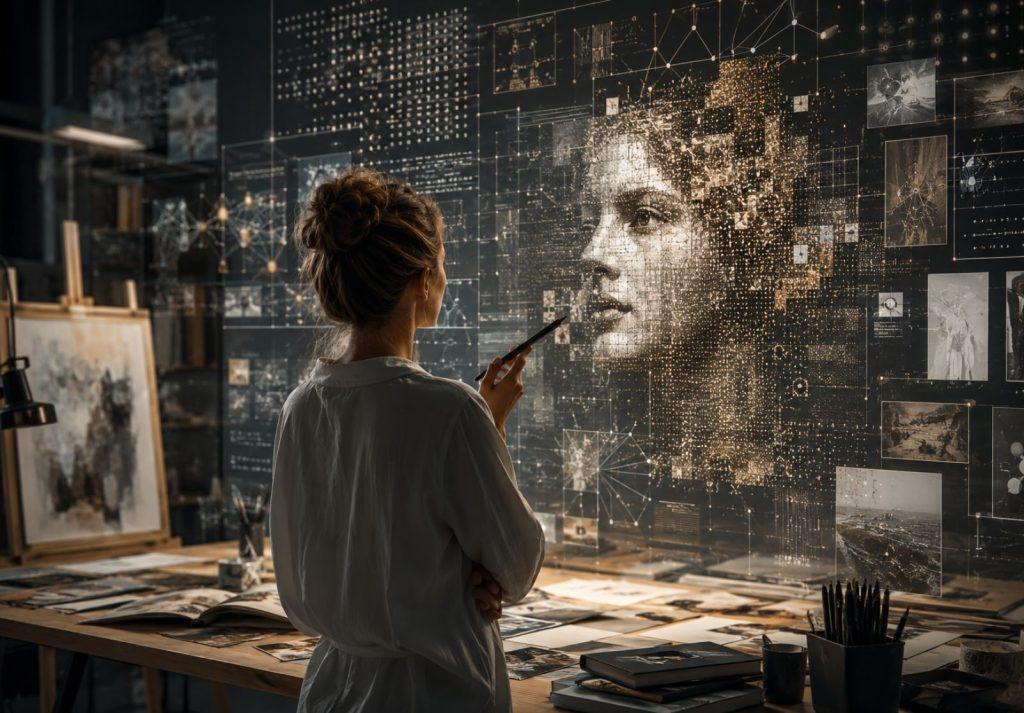
Where data spaces and curated art meet, stance decides perception.
4. Positioning in the AI Age: Orientation Instead of Overproduction
The faster content can be produced, the more important the question becomes: What do you stand for? In the context of AI, creative positioning is no longer just a marketing topic, but a curatorial act. It defines which topics, visual languages, and formats make sense—and which offerings are deliberately not pursued, even though the technology would allow it.
For museums and cultural institutions, this means: AI can enable personalized recommendations, virtual tours, and data-based analyses of visitor flows. But only a clear content positioning ensures that these technologies generate not only reach but cultural relevance—for example by strengthening certain perspectives, making marginalized voices more visible, or accompanying discourses over the long term (see current analyses on the role of AI in museums & cultural institutions).
For galleries, studios, and artpreneurs, the rule is: orientation beats mass. It is less about jumping on every trend in AI art marketing than about building a coherent narrative in which AI-powered content is just one of several forms of expression. Trust arises when collectors, partners, audiences, and community recognize that a consistent line stands behind the digital presence—and not just a series of random experiments with new tools.
📌 Key point: In the AI age, positioning becomes a navigation aid—for the audience, but also for one’s own decision-making in a hyper-accelerated environment.
5. Art & AI in the Market: New Forms of Production, Originality & Digital Reputation
The future of the art market is becoming increasingly hybrid. AI is becoming co-author, research instance, visualization tool—and in some cases an artistic voice in its own right, curated by humans. Artists use algorithms to analyze image archives, recombine historical forms, or create interactive, data-driven works. Museums experiment with AI-assisted restoration processes, galleries with virtual viewing rooms and AI-based recommendation systems for collectors (see Artnews & Forbes analyses on AI in the art market).
At the same time, the discussion about originality is shifting. When hyperrealistic visuals can be generated in seconds, the pure “look” loses exclusivity. What becomes more important is how a work is embedded in a context: Which sources are reflected? How transparent is the use of AI? What role does the audience play in the process? Digital certificates, process documentation, and curated making-of formats become building blocks of a digital reputation that goes beyond mere visibility.
For cultural marketing and the AI creative economy, that means: successful strategies combine technological efficiency with a clear awareness of copyright, ethical dimensions, and orientation toward the common good. Those who act transparently here position themselves not only as innovative but as a reliable actor in a market that is currently reorganizing itself.
6. The Biggest Misconceptions Among Many Creatives When Dealing With AI
Between skepticism and fascination, similar misunderstandings keep arising in the everyday life of artists, designers, photographers, cultural institutions, and galleries around art and AI:
- “AI replaces my artistic identity.” – AI can imitate styles, but it cannot take on a biography, a lived practice, personal responsibility. Identity arises from decisions over years, not from prompts in seconds.
- “If I use AI, I lose authenticity.” – What is decisive is how openly and reflectively its use is communicated. AI as a transparent tool within a clear conceptual framework can strengthen credibility rather than weaken it.
- “More output automatically means more visibility.” – Without clear positioning, higher frequency only leads to faster interchangeability. Visibility without stance remains fleeting—and makes it harder in the long run to build a consistent brand.
- “AI art marketing is only for big brands.” – Smaller studios, off-spaces, independent galleries, and artpreneurs in particular can benefit from AI to structure processes, develop editorial formats, and build reach in a targeted way—without large campaign budgets.
The central misconception remains, however: that technology alone could provide the answer to questions of visibility. Without clear creative positioning, without a cultural perspective, and without a deliberate choice of channels, even the best AI-powered output remains a random contribution in the data stream—instead of part of a recognizable, culturally connectable narrative.
7. Strategic Recommendations: How AI Art Marketing Can Be Used Sensibly
7.1 Clarify Positioning Before Choosing Tools
Before you test AI tools, a simple but consistent exercise is worthwhile: formulate in one sentence what your practice, your venue, or your gallery stands for—and in another what it does not. This clarity works like a filter for all further decisions in AI art marketing: Which visual languages fit? Which platforms make sense? Which collaborations strengthen your cultural brand—and which dilute it?
7.2 Develop a Cultural Perspective & Editorial Content
Visibility today arises not only through individual works or exhibitions, but through editorial formats: interviews, essays, curatorial notes, process documentation, digital magazines. AI can help here—for example in structuring texts, in translation, or in generating visual ideas—but the content direction remains a human task. Platforms like Favori Media work precisely at this interface: between editorial depth, cultural contextualization, and strategic visibility.
7.3 Integrate AI as a Tool in Everyday Studio Life
Instead of viewing AI as a separate sphere, it is worth looking at concrete fields of application in everyday work:
- Research & references: Image archives, historical sources, material studies can be reviewed and structured faster with AI.
- Prototyping & scenarios: Before elaborate productions start, visual scenarios, spatial concepts, or editorial spreads can be tested as AI-based sketches.
- Distribution & analysis: AI-powered analysis of performance data helps recognize patterns in your own digital visibility—which topics, image formats, or texts really generate resonance.
Solutions like Favori Flow or curated platforms like Favori Art can serve as infrastructure here to interlock creative processes, content formats, and distribution—without overlaying the artistic signature.
7.4 Strengthen Communities & Artpreneurs
For artpreneurs, collectives, and independent spaces, AI offers the chance to build professional visibility structures that used to be reserved for large institutions: editorial newsletters, curated social formats, digital edition platforms. What matters is to think about these possibilities not only technically but strategically: What role should your voice play in the cultural ecosystem? Which alliances make sense? Which rituals—such as recurring digital formats—can build trust over the long term?
7.5 Guiding Principles for Responsible AI Art Marketing
- Transparency: Disclose where and how AI is used in the process—especially in commercial campaigns.
- Respect for sources: Conscious handling of training data, references, and existing works—legally as well as ethically.
- Coherence over effects: Better fewer AI experiments used consistently than a loose sequence of spectacular but substantively unconnected visuals.
8. A Calm Conclusion: Visibility as Cultural Responsibility—Favori Media as a Partner
Technological developments are changing visibility faster than ever. AI accelerates production, differentiates distribution, and makes cultural marketing richer in data, but also more complex. In the interplay of AI, art, and the creative economy, it becomes clear: the central resource is not the tool, but clarity about what a practice, a venue, a brand wants to stand for culturally—and how that stance remains recognizable over years.
What remains decisive is how clearly cultural relevance, stance, and trust are perceived. This is exactly where the work of Favori Media comes in: as a strategic authority, cultural sparring partner, and modern thought brand that accompanies artists, cultural institutions, creative entrepreneurs, and galleries in developing long-term visibility architectures—from positioning through editorial concepts to AI-powered workflows like Favori Flow and curated platforms like Favori Art.