
- Art Market
- Galleries & Institutions
- Structural Critique
Cultural Sponsorship: Power, Dependency, and Culture
Why cultural sponsorship needs to be rethought, and who loses in the process
 AI-generated
Cultural sponsorship is rarely a symmetrical relationship. Those with little bargaining power carry the conditions, and in the end the audience often loses as well. It becomes healthier through alternatives, clear boundaries of one’s own and the willingness to defend them.
In most institutions, cultural sponsorship is told as a success story: a company supports an exhibition, a festival, an institution, and thereby enables cultural production that could not take place without these funds. This story is not wrong. But it is incomplete, and the gaps in this story concern precisely the actors with the least bargaining power.
Who actually wins and who loses in cultural sponsorship depends heavily on how a sponsorship relationship is structured, and this structure is rarely discussed publicly, even though it is central to the future of independent cultural production.
 AI-generated
The Invisible Asymmetry
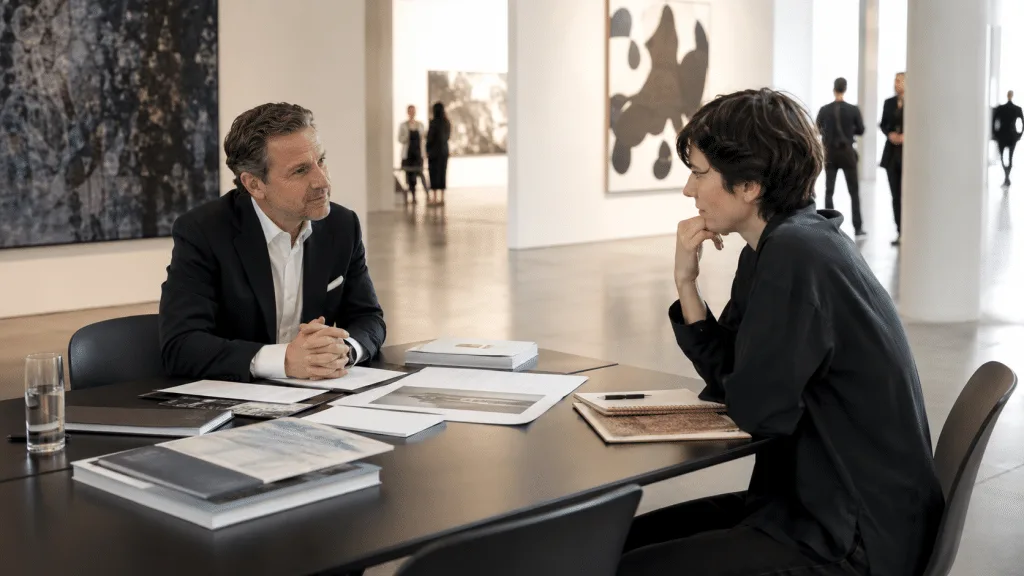
Sponsorship relationships in the cultural sector are rarely negotiated symmetrically. An established institution with a strong reputation, a major museum, an internationally known festival, negotiates from a position of relative strength. It can set conditions, limit brand integration, defend editorial independence.
A smaller institution, an independent festival, an individual artist in a sponsorship relationship negotiates from a fundamentally different position. The dependence on the funds is greater, the bargaining power correspondingly smaller. This is exactly where the asymmetry arises that the public discussion of cultural sponsorship mostly overlooks: it is not the principle of sponsorship that is problematic, it is the structural inequality in bargaining power between large and small recipients.
What Is Actually Being Negotiated
Sponsorship agreements rarely regulate only the amount of financial support. They also regulate visibility rights, brand integration, sometimes a say in content. The smaller the recipient institution, the more likely it is that these conditions turn out to be far-reaching, because the negotiating position allows it.
This shows up in details that seem harmless individually: the sponsor’s logo placed more prominently than the name of the institution itself. The expectation that artists attend the opening and interact with sponsor representatives. The silent expectation that controversial or politically sensitive positions be avoided when a sponsor comes from an industry that might be called into question by a particular artistic stance.
None of these conditions is usually formulated explicitly as a condition. They operate as silent expectations, and that is precisely what makes them so effective. An institution that is explicitly asked to self-censor can object. An institution that has internalized a silent expectation censors itself without a conflict ever arising.
Who Loses Structurally
The artists and institutions most disadvantaged in this system are not necessarily the poorest, but those with the weakest negotiating alternative. An institution that has several potential sponsors to choose from can reject conditions. An institution that depends on a single sponsor cannot.
This particularly affects smaller, independent cultural institutions and individual artists who enter sponsorship negotiations without institutional backing. They negotiate alone, without the experience, the bargaining power, or the alternative that larger institutions have. The result is often an acceptance of conditions that, on closer inspection, contradict their own artistic or institutional integrity, accepted not out of naivety, but out of structural necessity.
The Second Losing Group: The Audience
A second, less discussed losing group is the audience itself. When cultural programming is systematically shaped by sponsorship interests, even indirectly, even through silent expectations rather than explicit requirements, it changes which cultural positions get a stage at all.
This change is rarely dramatic or obvious. It shows in the accumulation of certain uncontroversial thematic tendencies and in the silent absence of others. Over time, what counts as “normal” cultural programming shifts as a result, not through censorship in the classic sense, but through a creeping pre-selection that is hardly visible because it is never named as such.
 AI-generated
What a Healthier Sponsorship Structure Could Look Like
The consequence of this analysis is not a rejection of cultural sponsorship in principle. Cultural production rarely has funds in abundance; sponsorship is and remains a necessary source of funding for many institutions and projects.
The consequence is a more conscious negotiating practice. Institutions and artists entering sponsorship negotiations benefit from defining editorial and artistic independence explicitly and in writing, not only when a conflict arises, but as the foundation of the agreement itself. Several smaller sponsors instead of one dominant main sponsor reduce dependence on a single negotiating party. And the willingness to decline sponsorship offers that are incompatible with one’s own positioning is itself a form of strategic strength, even if it costs funds in the short term.
The Structural Question That Remains
Cultural sponsorship will not disappear any time soon; public cultural funding in most European countries covers only part of the actual need. The question is therefore not whether sponsorship takes place, but under which structural conditions.
For smaller institutions and independent artists, this means: bargaining power does not arise from the amount of funding needed, but from alternatives, from clear boundaries of one’s own, and from the willingness to defend those boundaries even when the financial temptation is great. Those who do not actively build this bargaining power silently leave the conditions of cultural production to those who provide the money, and that is a structural shift that is rarely visible at the moment it happens.
Favori Media supports artists and cultural institutions in strategic positioning and funding structure, with a clear view of the conditions under which cultural independence is preserved.
Frequently asked questions
Who structurally loses in cultural sponsorship?
Mainly smaller institutions and independent players without a strong reputation or alternatives. They negotiate from a weak position and are more likely to accept conditions that limit their independence.
Why does this affect the audience too?
Because the program and editorial independence can shift when funders set conditions. The audience then sees culture that is shaped by interests more than is apparent.
What makes a healthier sponsorship structure?
Bargaining power that comes from alternatives, clear boundaries of one’s own and the willingness to defend those boundaries even when the financial temptation is great.


